
ClimateForce asks: What grows after cane?
ClimateForce forum
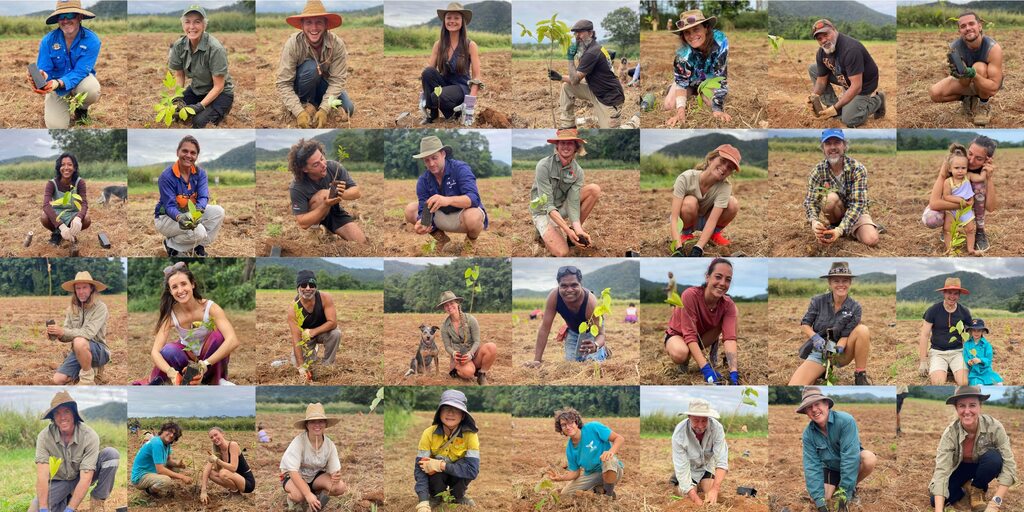
Farmers will share their own experiences and what has worked for them at a ClimateForce Common Ground: Future Land Use Forum this Thursday at Mossman Shire Hall, with an Open Farm Day at Cape Kimberley on Tuesday, November 17 to show what organic regeneration and diverse cropping look like in practice.
Biologist Gala Villagran Dichiara, a driver of ClimateForce, shares why she wants as many farmers and people from Douglas to attend the free events.
By Gala Villagran Dichiara
I came to meet the oldest rainforest on Earth. I stayed for its abundance, its people, and everything this land could still become.
I'm a biologist, and my work has taken me through jungle restoration, wildlife rescue and ocean conservation. More than anything, it has taught me to listen to the land. I come from Mexico, where for thousands of years people grew corn, beans and squash together in the milpa, each plant feeding the others. Wherever I have worked, the lesson has been the same: life is strongest where it is diverse.
Here in Douglas Shire, the land grew one crop for one mill for more than a century. Mossman Mill crushed its first cane in August 1897 and its last in November 2023. In March 2024 it went into liquidation. Before it closed, Canegrowers Mossman warned that up to a third of the town's population could be left without work.
Last week I sat on the patio of a farmer who grew some of the best cane in this district. As he talked about those years, his face lit up: the busy seasons, the backpackers who came from all over the world to work his land, the gatherings, the stories shared across languages. When the mill closed, he had to let go of his harvesters. "If you ask me, what am I going to with the land? I don't know."
I have seen this story before. In Mexico, I watched land that once grew the milpa turned over to single crops. It looked like progress, and for a while it was. But year by year the soil grew tired, the land became harder to bring back, and families came to depend on markets far away. It was nobody's fault. It was what the times asked of farmers.
It is the same here. Cane built families, schools and this town, and the people who grew it did exactly what was asked of them. But one crop and one mill is fragile, like a forest with a single species. In every ecosystem I have known, the ones that survive the storm are the diverse ones, held together by many roots. Communities are no different
That is why I see this moment not only as a loss, but as an opening. This district has rich soil, rain and sun, farmers who know their land better than anyone, and markets for crops we currently import. Life comes back when we give it diversity. People come back when they have real options.
That is what drew me to ClimateForce, a charity that manages a 213 hectare farm organically, on Eastern Kuku Yalanji Country, between the world's oldest rainforest and the Reef. It works a little like a modern milpa: native trees standing alongside crops like turmeric, cacao and durian, each layer supporting the next. They are testing what works here, making their own mistakes, and sharing what they learn with their neighbours.
The principle is simple, and very old: mimic nature. A rainforest never grows just one thing. It grows in layers, feeds its own soil and recovers after every storm. Life is abundant when it is diverse. Our farms can be abundant too, if we respect the cycles of the land instead of fighting them.
This is not about replacing cane. Cane can stay where it grows well. But there is room for so much more alongside it.
Some of the possibilities are surprising. Noni, a hardy fruit tree that grows wild along these tropical coasts, is sold as juice across Australia, yet much of it is imported from the Pacific Islands. Most of the world's turmeric is grown in India, and here it thrives in our climate. Australians already buy these crops. They could be grown right here.
What gives me the most hope is the spirit of sharing. ClimateForce is building free tools so farmers can map what they plant and learn from one another, so neighbours can plan together and reach buyers as a group. Old knowledge, like the milpa, meeting the knowledge of now. Nobody has to work this out alone.
I don't want to sell anyone a dream. Farming is hard: fuel costs, council rates, machines that break down, and a cyclone or flood that can wipe out a season. Nobody changes how they farm because of a film or a flyer. People change when they see it working on ground like theirs, and when they hear it from people they trust.
I think often of that farmer on his patio. I hope the good days come back for him: the land full of people again, backpackers arriving from around the world, music on a Saturday night. But this time with diverse crops growing in living soil.
Yes, the end of the mill was devastating. It is also a rare chance to come together and decide, as a community, what we want this land to give back.
That starts with coming together: to talk, to share what is working, and to find solutions as neighbours.
That is why ClimateForce is inviting everyone to the Common Ground: Future Land Use Forum on Thursday, November 12, from 3.30pm at Mossman Shire Hall. Farmers will share their own experiences, what has worked for them and ClimateForce will share the model they have been developing. Bring your property address or lot number and your farm can be mapped with you, for free. At 6.45pm we will close the evening with a screening of Kiss the Ground, a documentary about the soil beneath our feet and the farmers bringing it back to life.
The following Tuesday, November 17, from 9am to 1.30pm, the Open Farm Day at Cape Kimberley invites everyone to see what organic regeneration and diverse cropping look like in practice.
Both are free. No booking. Bring your family.
Let's keep sharing knowledge and solutions, so that one day, driving through this land, we see more abundance, and communities more resilient than ever.