
Port Douglas curlews clock in for duty on Phillip Island
CONSERVATION MISSION

BUSINESS FEATURE
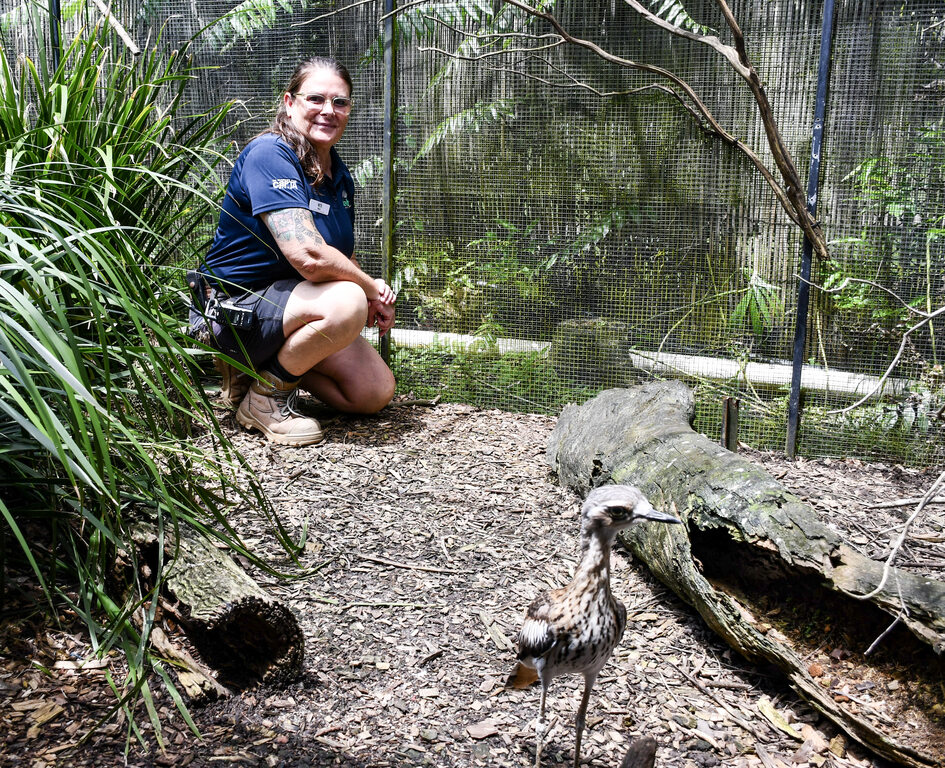
Two female Bush Stone-curlews, Josh and Wednesday, from Port Douglas have been sent on a rather important assignment to Phillip Island, Victoria, helping return their species to a place they vanished from decades ago.
The pair come from the Wildlife Habitat’s Tropical Animal Rehabilitation Centre (TARC), where for more than 20 years staff have rescued and rehabilitated native wildlife, from sugar gliders to northern bettongs. Now, it’s the curlews’ turn to take centre stage.
In recent years, TARC’s role has grown beyond rehabilitation, contributing to national conservation efforts, including the reintroduction of the Bush Stone-curlew to Phillip Island, where it has been extinct since the 1970s.
“Up here, people see them everywhere, but in southern states they’ve struggled due to introduced predators like foxes,” wildlife carer Rabecca Lynch said.
The species disappeared largely due to foxes, which preyed on ground-dwelling birds. Today, a rewilding program led by Phillip Island Nature Parks, alongside the University of Canberra and partners across Australia, is working to bring them back.
TARC’s involvement began with two birds that couldn’t return to the wild.
“We had a couple of female curlews that were really important genetically,” Ms Lynch said.
“They were wild birds that had been hand-raised and couldn’t be released because they were imprinted.”
Rather than being sidelined, the pair became vital to conservation efforts.
“Once it was clear they couldn’t be released, they became really valuable as part of a breeding program,” she said.
The curlews were transferred to Phillip Island, where they now form part of a carefully managed breeding population.
“Even though they were hand-raised and had lived in captivity, they adjusted really well,” Bec said.
Their offspring are raised by their parents before being released into predator-proof areas, where they are monitored and gradually re-established in the wild.
“The parents raise them, and then the young are released into the predator-proof area,” she said.
“Some birds are also fitted with small radio trackers so they can be monitored after release.”
The program’s success relies heavily on strict predator control. Foxes have been eradicated from the island using a combination of methods, including highly trained detector dogs.
“Because birds can fly over fences, they clip the primary flight feathers so they stay within the safe area while still moving naturally on the ground,” Ms Lynch explained.
While the Port Douglas birds have yet to breed, there is strong optimism for the seasons ahead. TARC is also preparing to expand its role.
“We’ve arranged to bring in a pair of curlews from South Australia, and hopefully we can breed them here and contribute offspring to the program,” she said.
The evolving role of zoos
Beyond curlews, the centre continues its wider conservation work, including breeding programs for the endangered Northern Bettong and rehabilitation efforts for the critically endangered Mahogany Glider.
For Bec, projects like this highlight how much zoos have changed.
“Zoos aren’t just about displaying animals anymore,” she said. “
They’re focused on conservation, maintaining strong genetics, managing breeding programs and supporting wild populations.
“We work closely with other facilities, moving animals to keep gene pools healthy and to help respond if numbers decline in the wild.
“There are partners across the country, zoos and conservation organisations all working together.
"That’s what conservation looks like now.”
------------
Want to showcase your business or event with a business feature? Please contact [email protected]