
It's proving popular to post a protest vote
CRISPIN HULL COLUMN

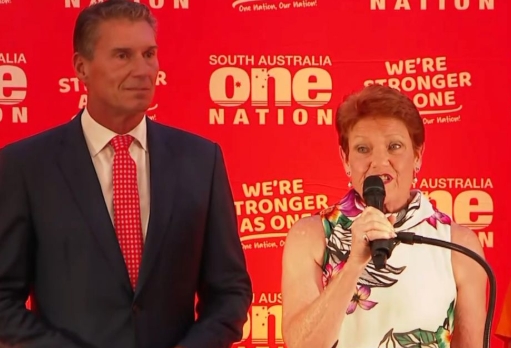
The South Australian election proves that One Nation is a far greater threat to the Liberal and National Parties than it is to Labor. We should ask why, and why One Nation poses such a threat to good government in Australia generally.
One Nation came second in the popular vote on Saturday, with 22 per cent, beating the traditional contestant for government, the Liberal Party, with just 19 per cent, into third place.
The single-member electoral system meant the high vote translated to only one or two seats, but it denied a lot of seats to the Liberals.
One Nation voters said: “We are fed up”; “I have had a gutful”; “I did a protest vote”.
The questions for those aspiring to government must surely be: What are they fed up with? What have they had a gutful of? What are they protesting against?
In the past, voters have often said things like this and, other than in Queensland in 1999, there has not been such a high One Nation vote.
This has been different because in the past the voters’ solution to being dissatisfied with a government was to put “the other lot” in. That has been the pattern from at least 1975.
But now voters are saying that giving “the other lot” a go is not a solution.
That is because “the other lot” on this occasion was the Liberal Party. And voters are alert to how that party has changed. Moreover, the voters themselves have changed.
From the mid-1980s in Australia, outsourcing, privatisation, downsizing, and deregulation put government in retreat. It was begun under the Hawke-Keating Governments but accelerated under subsequent Coalition Governments.
Prime Ministers John Howard, Tony Abbott, and Scott Morrison took the view that government should butt out and let the private sector get on with it. Doing that would make everyone better off.
The voters were onside to some extent with concern about bloated governments and wasteful misspending.
But over time voters changed. Voters now want government to fix things; to do things; to get involved in helping people with health, education, housing and the cost of living; and to stopping big, rich corporations and individuals exploiting people to gain even more wealth that they do not need.
Voters have witnessed declining government services and growing inequality as the top end of the private sector grabs most of the wealth, evades and avoids taxes, and rips off consumers. That is the inevitable consequence of downsizing, out-sourcing and deregulation.
Voters say they are fed up with waiting times, gap fees, poor public education, congestion, job insecurity, unfair taxes on labour and unfair tax breaks on the already wealthy.
But with Labor polling in the mid-30s, it is clear voters are not satisfied with Labor’s performance on these concerns either, at least federally. Labor was saved in South Australia because Premier Peter Malinaukus has been active in doing things and effective in communicating that, and polled 6 or 7 per cent above what federal Labor is polling. Prime Minister Anthony Albanese take note.
So, who do voters turn to?
Since 2007, the Liberal Party has slowly become a party of opposition to everything Labor does or wants to do expressed in often-contradictory glib sound-bites. Its only activity has been in silly ideological battles and internal leadership squabbling. It has no long-term plans for the nation because the Liberal Party’s core philosophy is small government, or do-nothing government, or do not get in the way of the richer getting richer.
It is instructive that One Nation did so well in the face of a fuel crisis that could have been avoided if the Coalition had not actively opposed renewables for two decades.
Obviously, One Nation voters don’t think down to that level of detail. But polls suggest that they have a general feeling that things are not going well and are not going to get better soon.
Hitherto, the Liberal and National Parties in Opposition had assumed that in that environment all they had to do was attack Labor and government would fall into their lap. It worked for Howard in 1996 and Abbott in 2013.
But the South Australian election shows that that strategy will no longer work.
It is a woeful position for Australia to be in. We have electoral systems federally and in most states that have yielded majorities – sometimes thumping majorities – for Labor when Labor gets a vote share in the mid-30s.
That has led to complacency and inattentiveness bordering on the lazy.
Federal Labor’s non-response to more than 150 parliamentary committees’ reports over the past four years is a case in point. Oodles of time, thought, and experience has been given by experts and ordinary players into suggesting how to fix whatever was being looked at: gambling, food labelling, vehicle standards, tax, algae in the rivers, air quality, financial abuse of the elderly. The list goes on and on.
And it is all being ignored. It adds to why people are “fed up”.
Acting to quietly fix these issues should be the bread and butter of government. They should be dealt with by public servants and routinely signed off by ministers.
But we do not have the depth and breadth in the Public Service to do this any more. The big accounting firms to whom government has been outsourced are not interested. And Ministers’ offices are only interested if an issue can be turned into a positive media event.
Combine this with the secrecy of modern government, and you a have recipe for grievance and conspiracy theories. That is why One Nation got 20 per cent of the vote – nearly all taken from the Liberal Party and delivering Labor an out-of-proportion majority.
That so many voters think that One Nation is the answer only tells us about the extent of the systemic incapacity of the major parties to govern efficiently, effectively, and transparently.
Of course, One Nation is no solution. Their new MPs will no doubt fight like cats in a sack until they escape to be independents or to other parties, as they have done so often in the past. They offer no realistic solutions, just complaints. But for now, that is so effective that it is alarming.
The results in South Australia’s proportionately elected upper house (three One Nation seats) indicate that One Nation is heading for at least six federal senators in 2028. Labor’s run of a friendly Senate will come to an abrupt end. All the more reason for Labor to be more active now.
Unless the Liberal Party abandons ideological idiocies and becomes electable again or enough teals and independents get elected to hold the balance of power and force Labor to start fixing things (or Labor fixes things itself), Australia is likely headed for more governmental paralysis.
This article first appeared in The Canberra Times and other Australian media on 24 March 2026.
*Crispin Hull is a distinguished journalist and former Editor of the Canberra Times. In semi-retirement, he and his wife live in Port Douglas, and he contributes his weekly column to Newsport pro bono.
- The opinions and views in this column are those of the author and author only and do not reflect the Newsport editor or staff.