
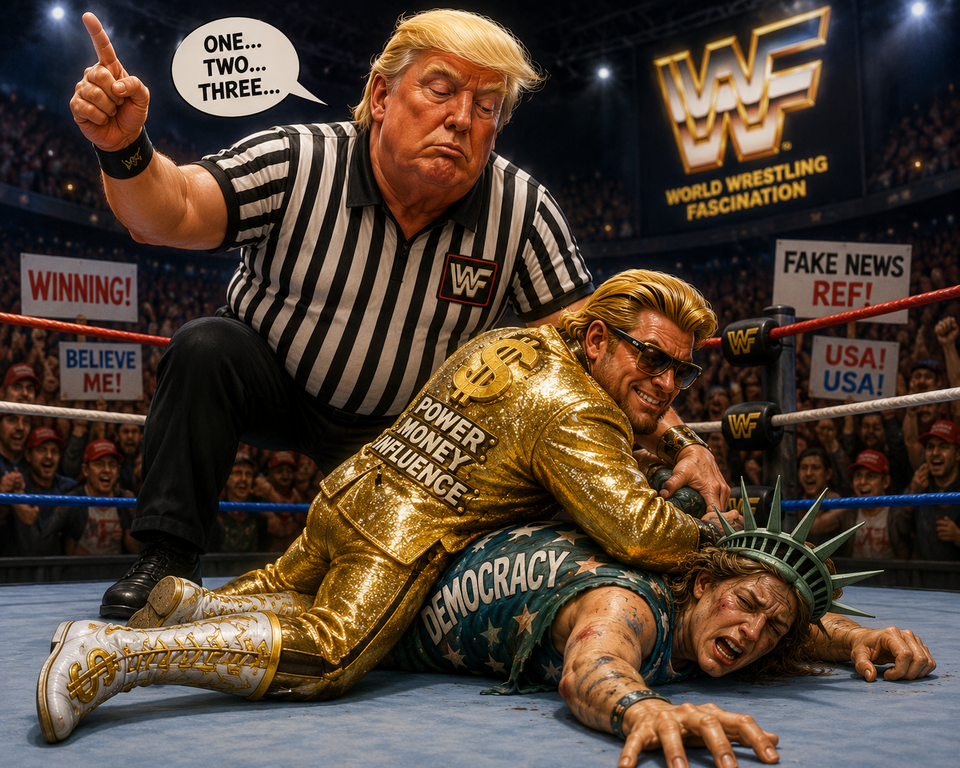
Donald puts Democracy on the ropes
CRISPIN HULL COLUMN
There was much to celebrate and be grateful for last Saturday as the US marked the 250th anniversary of the Declaration of Independence.
The declaration contained two of the most momentous concepts for humans: that humans are created equal with inalienable rights and that power is derived from the consent of the governed.
At the time, these were radical concepts indeed. Before then, humans had birthrights of rank or class and rulers drew their power by those birthrights though the doctrine of divine right. Or rulers drew power from conquest with the assertion that the conquest must have been divine will. That was the natural order of things and woe to anyone who objected.
Now “born to rule” is a derogatory expression. Legitimacy of action by government or even by the smallest organisation is gained by “putting it to a vote”.
The application of the two concepts – equality and consent – to government have contributed immensely to human happiness and freedom from fear.
Of course, the concepts were not fully applied from the date of the declaration. Slaves, women, and an array of minorities defined by race, religion, and sexuality did not obtain anything like equality for a long time.
Further, equality and consent of the governed are far from universal. But they have stood as aspirations both inside and outside the United States for the whole 250 years.
The declaration was the basis upon which the Constitution and Bill of Rights were founded. The Constitution separated the legislative, judicial and executive branches of government. This provided checks and balances that ensured that the Executive President did not wield too much power or wield power in an arbitrary way that infringed upon individual rights.
In short, the declaration, the Constitution and the Bill of Rights provided a model to which other nations could aspire. It gave rise to the notion of American exceptionalism – that America was the best and the way it did things was the only good way to do things. It introduced a certain amount of arrogance and military swagger because the best form of government was coupled with great economic and military strength.
Even so, Americans have every reason to be proud of their system of government. Conversely, that justified pride in the system of government should give rise to justified alarm when it is under threat or degradation, as it now is.
The declaration was mainly a statement of reasons why the American colonies could no longer accept rule by the King of England because the King (George III) was abusing his power. And now 250 years later the American President, Donald Trump, is abusing his power in a similar way – especially by overriding the will of the people.
In the King’s case it was ignoring or over-riding colonial legislatures. In the President’s case it has been ruling by Executive Orders that have overridden laws of Congress and overridden Congress’s appropriation of money for things that Trump has taken exception to – from water-saving shower heads to foreign aid.
There are many examples. On September 25, 2025 he permitted TikTok to operate despite a congressional ban;
On May 1, Trump ended federal funding for National Public Radio (NPR) and the Public Broadcasting Service (PBS). (Similar to Australian One Nation leader Pauline Hanson calling for the abolition of SBS and turning the ABC into a subscription service.)
Congress set up the Federal Election Commission (FEC), Federal Communications Commission (FCC), Securities and Exchange Commission (SEC), and Federal Trade Commission (FTC) to serve the public interest free from political interference. But a Trump Executive Order has demanded they submit their major regulations to the White House Office of Management and Budget (OMB) for review.
On January 27, 2025, Trump issued an executive order halting nearly all federal grants, including those funding public health, education, small businesses, and infrastructure projects. This caused deep disruptions across nearly every sector of the economy.
He defunded US foreign aid despite congressional approval.
Last December he designated fentanyl as a “Weapon of Mass Destruction”. This ostensibly gave him power to shoot boats suspected of drug running out of the water. About 200 crew have been killed since then, some of them probably innocent.
The list goes on.
In short, he has grossly and unconstitutionally encroached on the power of the people expressed through their elected representatives and is exercising power without the consent of the governed.
The question now is whether the constitutional system of government withstands this onslaught and whether the system of checks and balances will result in the judiciary stepping in to curb the abuse of power or whether Trump’s stacking of the Supreme Court with loyalists will mean that the abuse of power will go unchecked.
Will the checks and balances of the Constitution work? The other question is whether this sort of conduct has now been legitimised and can be continued by Trump’s successors.
(Mercifully, age will likely prevent Trump seeking a third term even if he tries to get around the constitutional prohibition against it.)
250 years later, people in many nations can be grateful for the American example. If the courts in the US fail to enforce the Constitution and curb the abuses of power, it will not mean that “government by the people, for the people, and of the people shall perish from the earth”.
Many other nations have adopted democracy and government by consent and have learned from the American experience, having come to it later. The lesson is that democracy cannot be taken for granted. It has to be worked on. Checks, balances and institutions and processes have to be strengthened so that extreme wealth and flawed characters do not gain and abuse power for their own ends at the expense of the people for whose benefit they are supposed to be governing.
This article first appeared in The Canberra Times and other Australian media on 7 July 2026.
*Crispin Hull is a distinguished journalist and former Editor of the Canberra Times. In semi-retirement, he and his wife live in Port Douglas, and he contributes his weekly column to Newsport pro bono.
- The opinions and views in this column are those of the author and author only and do not reflect the Newsport editor or staff.