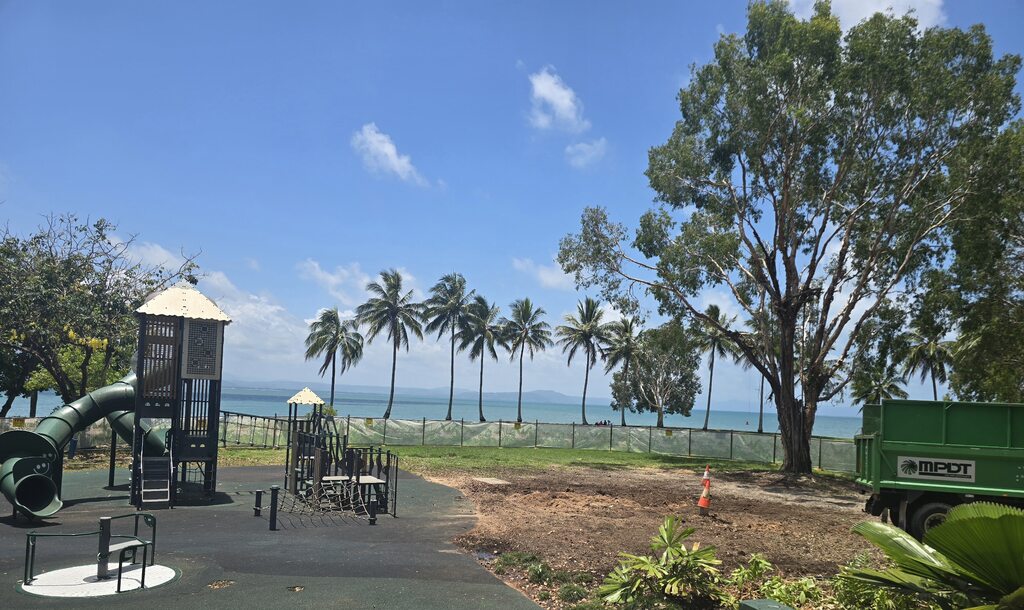
EXCLUSIVE: Playground played big role in Big Figgy's decline
Arborist Reports




An arborist report on Big Figgy in Rex Smeal Park done in April by James Watts from MPDT, the company which this week took four days to remove the tree, said defects in the tree could have been “easily rectified” and managed by remedial pruning.
But the 2024 installation of the playground and its rubber matting had placed extreme stress on the tree and the measures needed to save it would likely have been too much for it to survive.
Newsport obtained from the Supreme Court the series of arborist reports which led to Douglas Shire Council’s decision to remove the fig tree due to safety concerns. The Court acknowledged that the information provided for a matter that had been listed for November 16 but was dropped by Melina Capogreco due to the cost of running the case was “public information”.
Significantly, Mr Watts states in his April 28, 2025, report that the installation of the playground and playground surfacing is not in keeping with Australian Standards or the 2009 Protection of trees on development sites.
“The location of a new playground surface is a concern, impacting on the Structural Root Zone, installation and development design has hopefully minimised this impact with tree sensitive measures,” Mr Watts said.
“This has high potential for ill health to this tree in the long term.”
He says the playground surfacing is not of a material where tree roots can breathe or take water or nutrients, and has “contributed to the trees decline in health by root mass removal”.
His report also calls out the lack of maintenance on the tree, saying there had been no crown reduction and the heavy pruning required to save the tree had potential to further stress it and cause rapid decline in its health.
Previous pruning of the tree also had exposed the canopy of the tree on the southern side to new wind dynamics, with neighbouring trees being pruned also contributing to the impact of wind.
The playground covered a substantial area on the south to south western side of the tree and was a concern for tree health in the future due to being the main factor for ill health in trees, Mr Watts said.
His report identified two stems out of many that appeared to be in decline with rot pockets, something that was not uncommon for a tree of Big Figgy’s age.
“At present, these stems are still contributing to the overall structure but if more were impacted the integrity could be compromised.
That 2005 report concluded that the tree was in “reasonable condition” and the expert who promotes that he is “passionate about trees” rated it as a highly significant tree with high amenity value in a high-profile location with a long-life expectancy.
“Several defects in the upper crown have been detected that can be easily rectified and managed by remedial pruning in the form of a crown reduction, shape and rebalance with a crown lift to even canopy height,” he said.
“The percentage of a 1/3 of weight from the extremities of long lateral limbs should reduce the likelihood of limb failure and reduce the amount of wind shearing the canopy is exposed to at present.
“Care to be taken as supporting branches are to be considered and not to be removed to prevent weakening existing structure. Pruning back to substantial growth points and avoid stubs as a future pruning point.
“This is proactive management that will greatly reduce the chances of failure by reducing the size of the canopy and maintaining the size of the tree canopy spread as a maintenance regime.
“The defects in the upper crown were mainly from new wind exposure which now have been mitigated an stems at base had noticeable rot pockets which is approximately 1/6 of the supporting stems at base Of the tree…which isn't a high percentage.”