A debt of gratitude for Super idea
CRISPIN HULL COLUMN



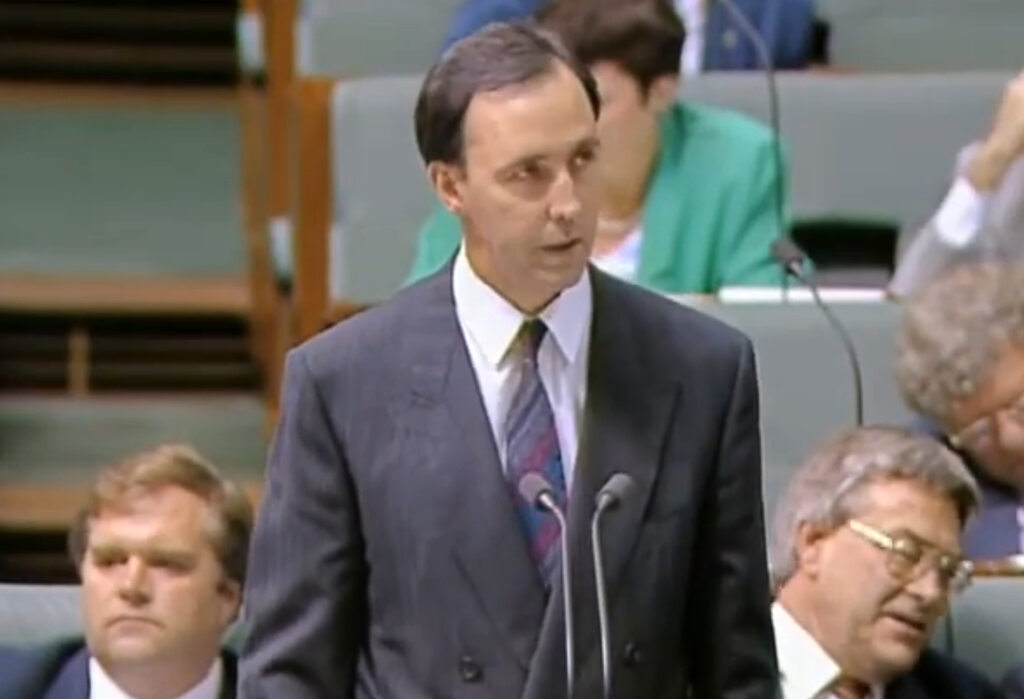
Here’s an interesting figure.
Australia’s household debt (mortgages, credit cards, loans, etc) is $3400 billion. Australia’s total superannuation assets are valued at $4400 billion.
Having a lot more assets than debt is a fairly secure place to be. Normally, fiscal conservatives would urge us to maintain that healthy balance sheet. But no, superannuation was set up by the Keating Labor Government, so it must be a Bad Thing.
Yet, arguably it is the best thing any Australian government has ever done.
If it had not been set up, that $4500 billion would have been squandered mostly on imported junk that would have ended up in landfill.
Instead, it will give millions of Australians a decent, secure retirement and relieve taxpayers of what would have been a massive government pension liability with an ageing population and a shrinking work-age population to support them.
That is worth noting as One Nation attempts to undermine the scheme with a simplistic appeal that people should be able to have “their” money now.
Last week, Treasurer Jim Chalmers released modelling that showed that the Government’s pension liability will come down over the next 40 years as nine million Australians hit the pension age, but only half will draw any government pension compared to two-thirds of people of pensionable age now.
We should be safeguarding and nurturing the superannuation scheme not chipping away at it with endless ideologically driven, harebrained, open-slather schemes to allow people early access to funds in their accounts.
Schemes to give people money from super to buy a home only increase demand and drive up housing prices. Other schemes for early access are often abused, such as paying for cosmetic dentistry.
Research by the Institute International Economic Policy shows that when the Morrison Government allowed people access to up to $20,000 of their superannuation to ease the burdens of Covid, Australians, especially low-wealth Australians with low super balances, jumped at it.
They withdrew the maximum allowed and went out and spent it on consumables, including gambling. They withdrew $38 billion. Typically, withdrawers took out half their balance, leaving them $120,000 worse off at retirement.
At the time, Treasury severely underestimated the reckless imprudence of low-wealth Australians.
Sadly, Australians are chronically incapable of resisting the urge to spend money on rubbish. We should be grateful that the Keating Government set up a scheme that forced us to save. We often whinge that governments only look at the short-term. Not so with super. It was a long-range (40-year), visionary project to provide for retirement.
Universal compulsory superannuation is part of the architecture of a decent society.
One Nation is incorrect in saying that money in individuals’ accounts is “their money”.
In reality, it is trust money. On one hand, the Government gives significant tax breaks as the money goes into a fund and on the earnings after it is in the fund. Without the superannuation scheme, people would be paying the full marginal tax rate (usually 30 per cent) on the money that goes into the fund instead of paying no tax on the first $30,000, and the full marginal tax rate (usually 30 per cent) on the earnings instead of 15 per cent. In return, the super account holder agrees not to access the money until they retire.
There was nothing in the One Nation policy about whether the account holder should repay to the government all the money gained by the tax breaks if they break their part of the agreement by getting early access. To the extent of the tax breaks, it is not “their” money.
There are several reasons the Coalition and One Nation want to undermine superannuation.
First, is the belief that the lucrative financial-management business should be the preserve of the finance industry which is largely populated by Coalition supporters, mates and donors, some of whom were found by the Royal Commission into Banking to be wanting at best, corrupt at worst, and certainly not doing all of their customers any favours.
Secondly, a system in which vast sums could be managed by non-profit, workplace-dominated organisations is an anathema to the Coalition and One Nation.
Thirdly, the pre-1990 position in which superannuation was in the gift of the employer gave employers a tool to keep employees subservient and loyal lest they lose their retirement income.
One Nation, however, once again, has read the mood of a significant portion of the electorate correctly.
Those voters are desperate because of inflation, medical and education costs and the cost of living generally. One Nation comes in and plays on the desperation and feeling that government is not working for them. The Government is holding “their” money and should give it back to them. One Nation will give relief now. And let’s ignore the long-term cost. This is outright deceptive.
It also diverts attention from the solution that cost of living could be better eased through government provision of services, but that would mean higher taxes on the very wealthy – again an anathema to One Nation and its biggest supporters like billionaire Gina Rhinehart.
Superannuation is one of One Nation’s very few specific policies. And if this is the best they can do, it is a pretty sorry state for a party that hopes to play a role in government.
They give no detail. One Nation MP Barnaby Joyce could not confirm whether the party had done any modelling on the long-term cost to account holders. The policy is at best an ill-conceived populist thought bubble.
One Nation and Coalition representatives (and they should be lumped together on this and many other issues) have called the superannuation scheme “broken”. That suggests that it does not work. But they never have the courage to say it should be abolished because it, like Medicare, has broad public support. Rather, like Medicare, they seek just to quietly undermine it.
The One Nation plan would allow people renting or paying off a mortgage to draw down a quarter of the money their employer is obliged to pay (pre-tax) into their superannuation accounts.
It is a 3 per cent tax holiday. For someone on $90,000 it would amount to just $44 a week. One Nation has garnered a lot of attention and perhaps extra voter support for what amounts to very little in the hand now at great cost later for the battlers it purports to strive for. It amounts to two cans of Coke or a takeaway coffee a day – a little bag of lollies today for a huge loss tomorrow.
An earlier undermining of superannuation by the Coalition was done in 1999 with the introduction of self-managed superannuation funds. This was unsurprisingly a boon for the finance industry. It enabled superannuation to be shifted from retirement-provision to elaborate tax-avoiding estate-management schemes. That is the only part of the superannuation scheme that should be wound back.
It also took money away from non-profit industry-managed funds (but nowhere near as much as the Coalition hoped for). About a fifth of the superannuation pool is now in self-managed funds. Even so, when you take that out, the pool of superannuation funds held by working Australians and retired workers is still greater than household debt.
Overall, the superannuation system ain’t broke, so any call to “fix” it is just a politically self-serving ruse.
*Crispin Hull is a distinguished journalist and former Editor of the Canberra Times. In semi-retirement, he and his wife live in Port Douglas, and he contributes his column to Newsport pro bono.
- The opinions and views in this column are those of the author and author only and do not reflect the Newsport editor or staff.